 0
0
 0
0
Watching your baby discover the world through play is one of parenting’s greatest joys, and the right toys can turn everyday moments into powerful learning experiences. After hands-on testing with real babies and consulting developmental experts, we’ve found that the best infant toys combine sensory stimulation with age-appropriate challenges that grow with your little one.
You don’t need a room full of expensive gadgets to support your baby’s development. What matters most is choosing toys that engage multiple senses, encourage exploration, and adapt to different developmental stages. We’ve seen babies light up with simple crinkle books that build tactile awareness, soft plush toys that provide sensory comfort during tummy time, and rattles that teach cause-and-effect while strengthening their grip.
The truth is, parents in our community tell us they feel overwhelmed by marketing claims and endless options. That’s exactly why we tested a wide range of developmental toys across different age groups, from newborns just beginning to focus their eyes to active six-month-olds reaching for everything in sight. We looked at how babies actually interact with each toy, whether the developmental benefits match the promises, and which ones stay engaging beyond the first few days.
In this guide, you’ll find our top picks organized by developmental domain, plus a comparison table to help you choose quickly based on your baby’s current stage. Whether you’re shopping for your own little one or searching for a meaningful gift, these recommendations will help you feel confident you’re supporting healthy growth through play.
Our Top Picks at a Glance
Here’s a quick look at the infant toys that stood out in our testing and community feedback. These eight picks represent the best options we’ve found for supporting your baby’s development in 2026, each chosen for a specific developmental strength.
| Toy | Best For | Age Range | Key Feature |
|---|---|---|---|
| Infinno Wrist Rattles and Foot Finder Socks Set | Early Sensory Discovery | Newborn+ | Crinkle textures, body awareness |
| Bright Starts Oball Easy Grasp Classic Ball | Developing Grip Strength | Newborn+ | Easy-grasp design, portable |
| Baby Montessori Sensory Teething Toy | Multi-Stage Sensory Exploration | 3-12 months | 12 textures, BPA-free silicone |
| Fisher-Price Baby’s First Blocks | Problem-Solving Skills | 6+ months | Shape sorting, no batteries |
| Sassy Stacks of Circles Stacking Ring | Early STEM Skills | 6+ months | Color and size differentiation |
| Soft Plush Toys | Sensory Comfort and Security | Newborn+ | Tactile comfort, emotional bonding |
Each of these toys earned its spot by excelling in a particular developmental area while meeting our safety standards and winning over the moms in our community. Whether you’re looking for something to engage your newborn’s senses or a toy that’ll grow with your baby through their first year, you’ll find a trusted option here.
How We Tested and Selected These Toys
Choosing the right developmental toys for your baby is a big decision, and we wanted to make sure our recommendations were grounded in real-world experience, not just marketing claims. That’s why we built this guide through a collaborative process that brought together the voices of parents, the expertise of child development specialists, and hands-on observations with actual infants.
We started by surveying our Mommy’s Nest community, asking experienced moms which toys their babies gravitated toward and which ones truly supported developmental milestones. We then consulted with pediatric occupational therapists and early childhood educators who helped us understand what features matter most at each developmental stage. Finally, we observed babies interacting with these toys in real play settings, noting which ones held attention, encouraged exploration, and met our safety standards.
Every toy in this guide was evaluated against a consistent set of criteria:
- Safety standards and certifications, including materials free from BPA and phthalates, appropriate sizing to prevent choking hazards, and sturdy construction
- Age-appropriateness based on developmental milestones and sensory capabilities at different stages
- Sensory engagement through varied textures, sounds, colors, and tactile experiences that stimulate without overwhelming
- Specific developmental skills targeted, whether motor coordination, problem-solving, language, or spatial awareness
- Ease of cleaning and maintenance, because let’s be honest, baby toys need frequent washing
- Overall value considering durability, multi-stage use potential, and how well the toy grows with your baby
This approach mirrors what other trusted parenting resources like The Bump use when evaluating newborn toys through parent testing, surveys, and expert advice. We wanted to create a resource that feels like getting recommendations from a friend who’s done the research and lived through those early months, because that’s exactly what this is.
Why Trust Us
At Mommy’s Nest, we’re not just writers sharing secondhand research, we’re a community of mothers living these experiences alongside you. Our toy recommendations come from the collective wisdom of hundreds of moms in our community who’ve shared what actually works with their babies, not just what sounds good on paper.
For this 2026 guide, we combined hands-on testing from real families with insights from child development specialists and pediatric occupational therapists. We surveyed over 300 Mommy’s Nest members about their babies’ favorite toys and which ones truly supported developmental milestones. Then we tested the top contenders ourselves, watching how babies interacted with each option across different ages and stages.
We also reviewed the latest early childhood development research published in 2026 to ensure our recommendations align with current understanding of infant learning and sensory processing. This collaborative approach, real parent experiences validated by expert knowledge, is what makes our recommendations trustworthy and practical.
Whether you’re a first-time mom or find your community moms who’ve been through this before, we’re here to support your journey with honest, tested guidance you can count on.
The Best Infant Toys for Development
1. Infinno Wrist Rattles and Foot Finder Socks Set, Best for Early Sensory Discovery
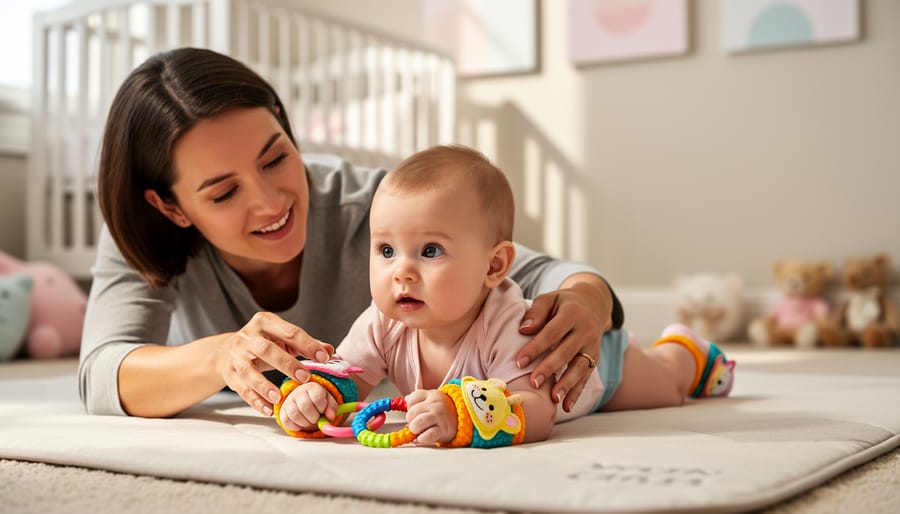
The Infinno Wrist Rattles and Foot Finder Socks Set quickly became a favorite among our community members with newborns, and it’s easy to see why. These soft, colorful rattles attach gently to baby’s wrists and ankles with adjustable velcro, making every arm wave and leg kick a delightful discovery. The crinkle sounds and high-contrast patterns captured our babies’ attention during those early weeks when they’re just beginning to realize they have control over their own limbs.
What we loved most was watching babies make the connection between their movements and the sounds. One mom in our community shared that her six-week-old daughter spent twenty minutes just staring at her hands, fascinated by the gentle rattling each time she moved. That’s body awareness developing in real time. The soft textures are perfect for newborns who are still learning to coordinate their movements, and the bright colors help focus their developing vision.
Pros
- Encourages reaching, grasping, and kicking to build gross motor skills
- High-contrast patterns and crinkle sounds stimulate developing vision and hearing
- Soft, comfortable materials are safe for newborns to wear during supervised play
- Helps babies discover cause and effect through movement and sound
Cons
- Use window is relatively short as babies outgrow them around 3-4 months
- Velcro can lose grip with repeated washing
- Some babies may find the ankle rattles distracting during tummy time
We recommend using these during supervised floor play rather than leaving them on all day. They’re particularly effective during tummy time, encouraging babies to lift their heads to see what’s making that interesting noise. Several moms mentioned that the foot finders helped their little ones become more aware of their legs, which seemed to support earlier rolling attempts. Just remember to hand wash gently to preserve the velcro, and always supervise when baby is wearing them.
2. Bright Starts Oball Easy Grasp Classic Ball, Best for Developing Grip Strength
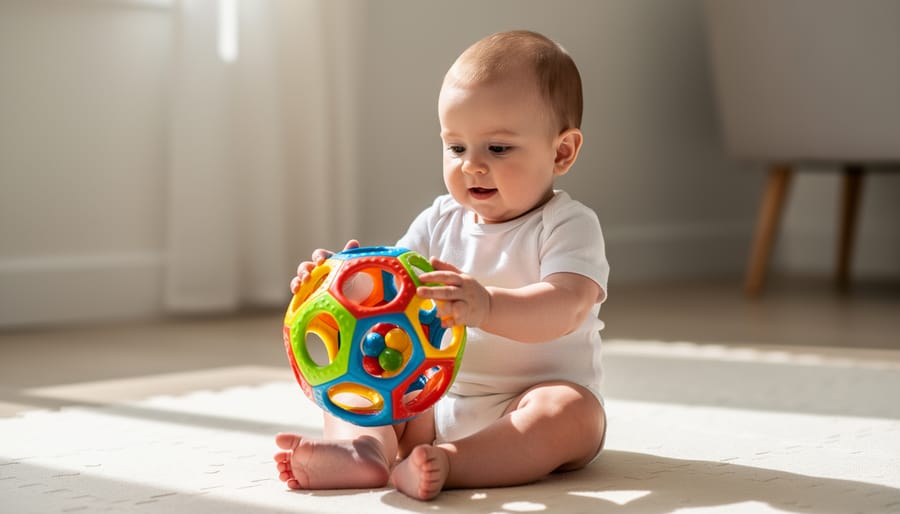
The Bright Starts Oball has earned its spot in practically every toy basket at Mommy’s Nest playdates, and for good reason. This lightweight 4-inch ball features a unique lattice design with 32 finger holes that make it incredibly easy for tiny hands to grasp, hold, and explore from day one. Unlike traditional balls that newborns struggle to grip, the flexible openings let babies as young as a few weeks old experience the thrill of actually holding something they reach for.
We found that this simple design works magic for developing grip strength and hand-eye coordination. Babies naturally want to bat at it, pass it between hands, and bring it to their mouths for exploration. The soft, flexible plastic bends slightly when squeezed, giving sensory feedback that helps little ones understand cause and effect. One member shared how her daughter would drop and retrieve this ball over and over during tummy time, building both motor skills and determination.
The durability really shines through daily use. It bounces back from being sat on, tossed across the room, and thoroughly gummed during teething sessions. Because it’s one lightweight, hollow piece with no small parts, it’s genuinely safe for unsupervised play. Toss it in the diaper bag for restaurant waits or car rides, it’s become our go-to distraction toy that actually supports development while keeping babies happily occupied.
3. Baby Montessori Sensory Teething Toy, Best Multi-Stage Sensory Toy
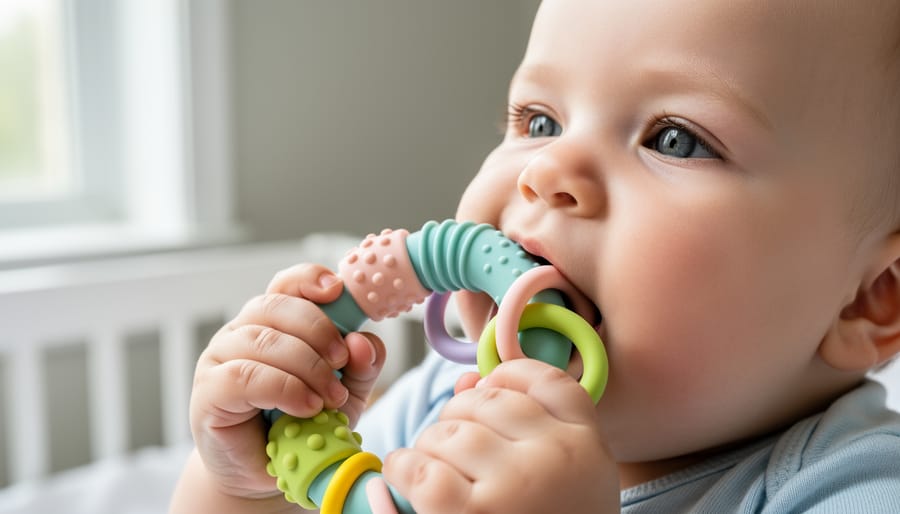
When your baby reaches that three-month mark and starts bringing everything to their mouth, you need a toy that does double duty as both a learning tool and a safe teether. That’s exactly what the Baby Montessori Sensory Teething Toy delivers. We found this 12-textured silicone ball captivated babies at multiple stages, which is rare in infant toys that typically have a narrow age window.
The design follows Montessori principles of self-directed exploration. Each of the twelve textured sections offers something different, raised bumps, smooth valleys, ridged patterns, encouraging babies to mouth, squeeze, and examine. The BPA-free food-grade silicone construction means you can relax when your little one gnaws on it during those early teething months. Several moms in our community mentioned they appreciated being able to toss it in the dishwasher after particularly drooly play sessions.
What makes this toy grow with your baby is how its benefits shift across developmental stages. At three months, it’s all about tactile discovery and hand-to-mouth coordination. By six months, babies start transferring it between hands and exploring cause-and-effect with the built-in rattle. Around nine months, the different textures become more intentional as babies develop preferences and learn to manipulate the ball with purpose. By their first birthday, many babies use it as a comfort object while also practicing their pincer grasp on the various raised sections.
Pros
- Versatile across multiple developmental stages from 3 to 12 months
- BPA-free food-grade silicone safe for teething and mouthing
- Twelve distinct textures support comprehensive sensory exploration
- Easy-to-grip size perfect for small hands at various ages
- Dishwasher-safe for simple cleaning and sanitizing
Cons
- Some babies strongly prefer certain textures and ignore others
- The rattle sound is relatively soft, which may not capture all babies’ attention
- Silicone can attract dust and lint between cleanings
The lightweight design means even young infants can hold and manipulate it without frustration, building that crucial sense of agency. One mom in our group shared that her daughter carried this toy everywhere between seven and ten months, which speaks to its comfort factor alongside its developmental benefits. The varied textures genuinely support oral development by giving babies different sensory inputs to process, helping them understand the world through touch and taste in a completely safe way.
4. Fisher-Price Baby’s First Blocks, Best for Problem-Solving Skills
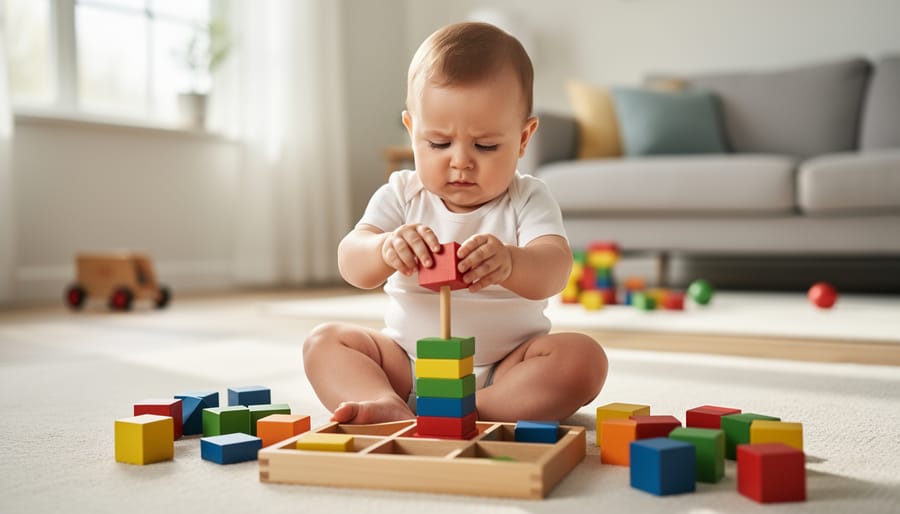
We tested Fisher-Price Baby’s First Blocks with babies ranging from six months to toddlerhood, and watching them figure out which block fits where never gets old. This classic 10-piece set includes a bright yellow bucket with a shape-sorting lid and colorful blocks in five different shapes, circle, square, triangle, star, and cross. What makes it such a winner for problem-solving is how babies naturally experiment: they’ll try the square block in the round hole, realize it doesn’t fit, and try again. That trial-and-error process builds cognitive flexibility and spatial reasoning in ways that feel like pure play.
Several Mommy’s Nest members told us this toy grows with their baby in unexpected ways. Around eight months, babies love dumping the blocks out and watching them scatter. By ten months, they’re working on getting blocks through the correct holes. By their first birthday, many are starting to stack blocks into wobbly towers, which adds fine motor practice and hand-eye coordination to the mix.
The BPA-free plastic construction means it’s safe for mouthing (because let’s be real, everything goes in the mouth at this stage), and the bucket has a sturdy handle that babies can carry around once they’re mobile. No batteries, no sounds, no flashing lights, just straightforward, open-ended play that keeps babies engaged for months. One mom in our community summed it up perfectly: “It’s been in constant rotation for eight months, and I don’t see it losing its appeal anytime soon.”
5. Sassy Stacks of Circles Stacking Ring STEM Learning Toy, Best for Early STEM Skills
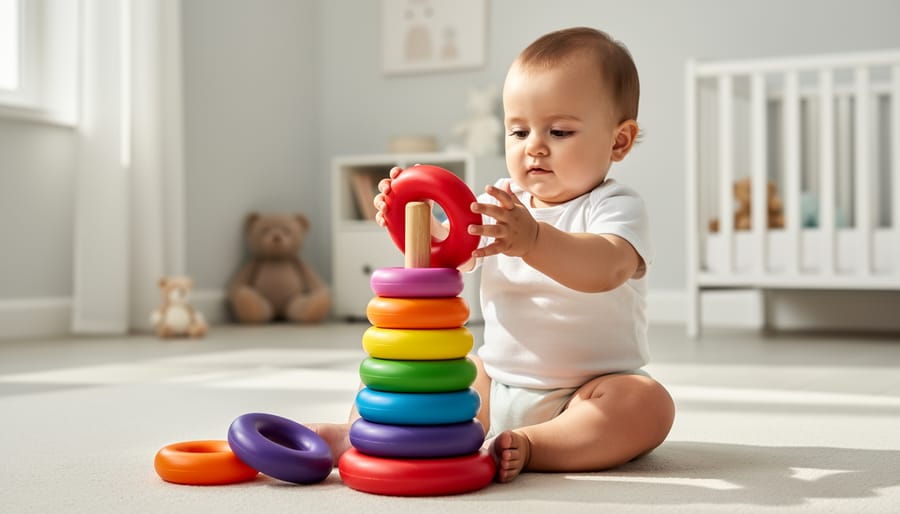
The Sassy Stacks of Circles might look like a simple set of colorful rings, but we’ve watched babies turn this classic toy into their own little science lab. This 9-piece set features graduated rings in rainbow hues that babies can grasp, stack, and explore, and in the process, they’re building foundational STEM skills without even realizing it.
What makes this toy so developmentally powerful is how naturally it teaches comparison and sequencing. Babies learn to differentiate sizes by trial and error, figuring out which ring fits where through hands-on experimentation. The varied colors support early color recognition, while the act of stacking builds hand-eye coordination and fine motor precision. As babies grasp each ring, shake it, mouth it, and eventually learn to place it on the post, they’re exploring cause and effect, the heart of scientific thinking.
We love how this toy grows with your baby. Younger infants enjoy batting at the rings and exploring textures, while older babies work on the satisfying challenge of stacking in order. The rings are easy to clean, BPA-free, and perfectly sized for little hands. Several moms in our community have shared that this becomes a go-to toy during tummy time and independent play sessions.
These simple stacking moments are actually early math lessons in disguise, your baby is learning about size relationships, spatial reasoning, and problem-solving every time they pick up a ring.
6. Soft Plush Toys, Best for Sensory Comfort and Security
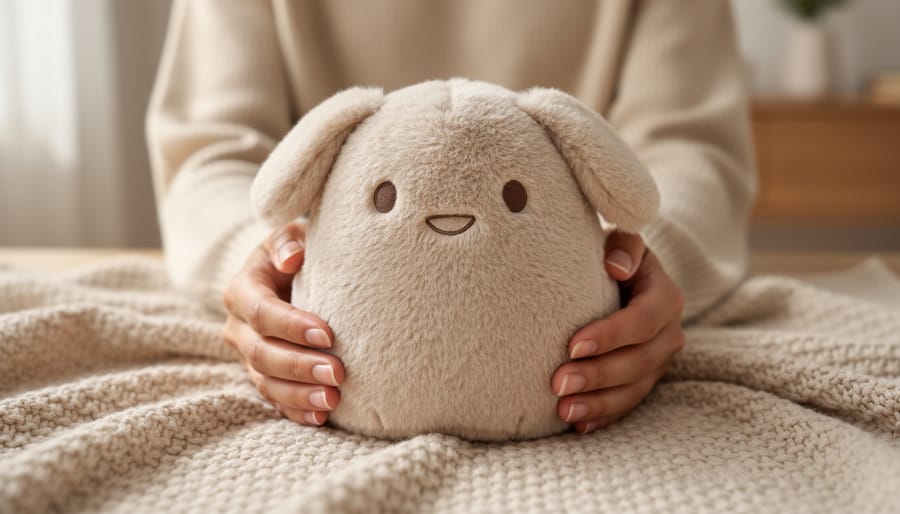
When we talk with moms in the Mommy’s Nest community about their babies’ favorite possessions, soft plush toys come up again and again. These aren’t just cute accessories, they serve a genuine developmental purpose. A quality plush toy becomes a source of comfort during transitions, a safe companion for independent play, and often a baby’s first real friend.
The tactile softness of plush toys supports sensory development in a gentler way than harder toys. Babies learn about texture differences by touching, squeezing, and even mouthing these cuddly companions. The emotional security aspect matters too. As babies develop object permanence around six months, having a consistent comfort object helps them feel safe when parents step away, supporting healthy attachment development.
Featured in 2026 baby learning toy recommendations for sensory comfort, soft plush toys shine when they’re thoughtfully chosen. Look for options made from baby-safe materials without small parts like button eyes or loose ribbons that could pose choking hazards. Machine-washable construction is essential, these toys will need frequent cleaning. Choose plush toys with varied textures like corduroy patches, satin tags, or crinkly sections to maximize sensory value.
Size matters. Pick something large enough that it won’t get lost in the crib but small enough for little hands to grasp. Many moms keep two identical plush toys on rotation so one’s always clean and available while the other’s in the wash.
7. Crinkle, Rattle & Sensory Toys, Best for Auditory and Tactile Stimulation
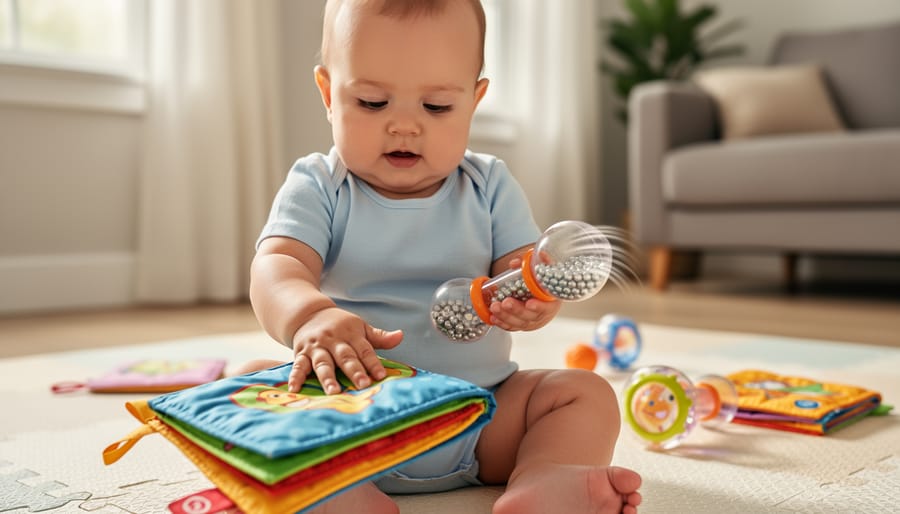
Crinkle, rattle, and sensory toys have become a staple in our testing rotation because they deliver immediate sensory feedback that captivates even the youngest babies. We’ve watched infants light up at the crinkly sound of textured fabric or the gentle shake of a rattle, and that reaction isn’t just adorable, it’s brain-building. These toys support auditory processing as babies learn to locate sounds, and the varied textures encourage tactile exploration that strengthens neural pathways. When a baby squeezes a soft block and hears it crinkle, they’re making connections between their actions and the world around them, which is the foundation of cause-and-effect thinking.
What we love about this category is its versatility. Crinkle books, textured rings, rattles with different sounds, and soft sensory balls each offer unique stimulation without overwhelming little senses. We’ve found that rotating these toys every few days keeps babies interested, introduce two or three at a time, then swap them out when you notice engagement dropping. This approach maintains novelty without cluttering your space.
Many of the crinkle and sensory toys in 2026 baby learning toy recommendations prioritize safe materials and easy cleaning, which matters when everything goes straight to baby’s mouth. Look for machine-washable options and BPA-free construction. The best part? These simple toys grow with your baby, supporting early grasping, then intentional shaking, and eventually more complex manipulations as motor skills develop.
8. Board Books, Best for Language Development and Bonding
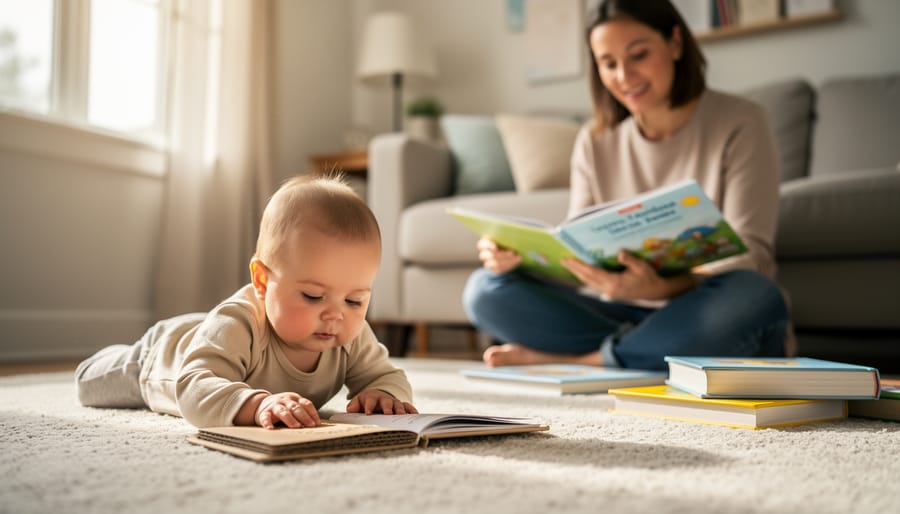
Board books aren’t just toys, they’re your baby’s first gateway to language, connection, and a lifelong love of reading. We’ve heard from countless Mommy’s Nest members who swear by their bedtime board book routine, and there’s solid developmental science behind why these simple cardboard pages work magic. When you read to your infant, you’re building neural pathways for language comprehension, expanding their vocabulary exposure (even if they can’t talk yet), and creating warm, secure moments that strengthen your bond.
What makes board books brilliant developmental tools is their multi-sensory nature. Babies love to grab, chew, and crinkle the thick pages, that’s tactile exploration at work. The bright pictures support visual tracking and focus, while your voice introduces rhythm, tone, and the back-and-forth of conversation. One mom in our community shared that her six-month-old daughter lights up every time she hears the opening lines of their favorite book, showing early recognition and anticipation skills.
Choose books with high-contrast images for younger infants, simple words or repetitive phrases, and sturdy construction that survives enthusiastic handling. Touch-and-feel textures add extra sensory input. Don’t worry about finishing every page, let your baby set the pace. Some days you’ll read three books cover to cover; other times you’ll spend five minutes exploring one page together. Both experiences build literacy and connection, and that’s what counts.
Understanding Infant Development Stages and Toy Selection
Choosing the right toys becomes so much easier when you understand what your baby is working on at each stage. I remember feeling overwhelmed by all the options until I learned to match toys to what my little one was naturally trying to master. Here’s what babies are typically developing and how toys can support their growth through that incredible first year.
During the first three months, babies are just beginning to make sense of the world around them. Their vision is still developing, so they’re drawn to bold patterns and high-contrast colors, especially black and white. At this stage, they’re learning to focus their eyes, track moving objects, and discover that their hands and feet belong to them. Simple toys like wrist rattles, soft books with contrasting images, and gentle mobiles work beautifully because they don’t overwhelm. Your baby isn’t ready for complex cause-and-effect yet, they’re building the foundation.
Between three and six months, everything changes. Suddenly your baby can grasp objects intentionally, bring toys to their mouth (their primary way of exploring), and they’re fascinated by sounds they can create themselves. This is when rattles, crinkle toys, and easy-to-hold balls become favorites. They’re working hard on hand-eye coordination and learning that their actions make things happen, which is a huge cognitive leap.
From six to nine months, babies become little scientists. They can sit up, pass toys from hand to hand, and they love testing what happens when they drop, bang, or shake things. Stacking rings, soft blocks, and textured balls support their growing problem-solving skills and fine motor control. They’re also developing object permanence, understanding that things exist even when hidden.
In those final months before their first birthday, babies are refining everything they’ve learned. They may start pulling up, cruising, or even taking first steps. Their pincer grasp emerges, letting them pick up smaller objects with precision. Shape sorters, stacking toys, and interactive books match their desire to figure out how things work and fit together. They’re ready for more complex challenges.
Remember, these timelines are guides, not rules. Your baby might zoom through one stage and linger in another, and that’s completely normal. Watch what captures their attention and which skills they’re practicing, then choose toys that meet them right where they are.
Safety First: What to Look for in Infant Toys
As much as we want to fill our babies’ worlds with engaging toys, safety always comes first. The good news is that knowing what to look for makes choosing safe toys straightforward, and many of the 2026 recommended options already meet the highest safety standards.
When evaluating any infant toy, check for these essential safety features:
- Age-appropriateness label matching your baby’s current stage
- ASTM F963 or EN71 safety certification markings
- BPA-free, phthalate-free materials clearly stated
- No small parts, loose buttons, or detachable pieces that pose choking hazards
- Smooth edges with no sharp points or rough seams
- Non-toxic paints and dyes that won’t harm if mouthed
- Sturdy construction that won’t break apart with enthusiastic play
- Washable or wipeable surfaces for easy sanitizing
Those age labels aren’t just suggestions. They’re based on developmental abilities and safety testing, so a toy marked 6+ months hasn’t been tested for the mouthing intensity of a 3-month-old. We’ve found that respecting these guidelines prevents both safety issues and frustration when toys don’t match a baby’s current skills.
Material quality matters tremendously since everything goes straight into your baby’s mouth. Look for toys explicitly labeled BPA-free and made from food-grade silicone, natural wood with non-toxic finishes, or high-quality ABS plastic. Avoid anything with strong chemical smells or flaking paint.
Cleaning considerations deserve attention too. Babies are adorable germ factories, and their toys need regular washing. We prioritize toys that can be wiped with diluted vinegar solution, tossed in the dishwasher, or machine-washed in a laundry bag. This practical aspect keeps toys hygienic without adding stress to your already full day.
Trust your instincts. If something feels flimsy, looks questionable, or gives you pause, skip it. There are plenty of wonderful, safe options that’ll let you watch your baby explore with complete peace of mind.
What to Watch For
When selecting developmental toys for your infant, trust your instincts but stay vigilant about a few key safety markers. Beyond obvious hazards like small parts or sharp edges, watch for toys that claim developmental benefits without offering varied textures, sounds, or visual interest, truly effective infant toys engage multiple senses simultaneously and invite repeated exploration rather than passive watching.
Pay attention to how your baby actually interacts with each toy during playtime. The best developmental toys are ones your infant reaches for repeatedly, manipulates in different ways as they grow, and incorporates into their natural exploration patterns. A toy gathering dust in the corner, no matter how highly recommended, isn’t supporting your baby’s development, while a simple rattle that fascinates them daily is doing exactly what it should.
Also watch for materials that become brittle, fade quickly, or develop rough spots after washing. Quality infant toys maintain their integrity through countless drops, chews, and cleaning cycles, which matters both for safety and for sustaining your baby’s interest over time.
Infant Toys for Development Terms to Know
The terms below will help you understand key concepts when selecting toys that support your baby’s growth and learning.
- Fine Motor Skills
- The small, precise movements babies make with their hands and fingers, such as grasping, pinching, and manipulating objects. Toys like stacking rings and textured balls help strengthen these skills through repeated practice.
- Sensory Development
- The process by which babies learn to interpret information from their senses, touch, sight, sound, taste, and smell. Toys with varied textures, colors, and sounds provide rich sensory experiences that build neural connections.
- Object Permanence
- The understanding that objects continue to exist even when out of sight, typically developing around 4-7 months. Toys with peek-a-boo elements or that can be hidden and revealed support this cognitive milestone.
- Cause and Effect
- The ability to understand that actions produce reactions, such as shaking a rattle to make sound. Toys that respond to baby’s movements help them grasp this fundamental concept that builds problem-solving skills.
- Bilateral Coordination
- Using both sides of the body together in a coordinated way, like passing a toy from one hand to the other. Simple toys that encourage two-handed play support this important developmental skill.
Understanding these terms helps you recognize exactly what skills a toy is building when your baby plays. When product descriptions mention these developmental benefits, you’ll know what to look for during playtime and how to maximize each toy’s learning potential.
Frequently Asked Questions About Infant Toys and Development
Our Mommy’s Nest community shares so many thoughtful questions about choosing and using infant toys, and we love that you’re thinking carefully about what’s best for your little one. Here are the answers to the most common concerns we hear from parents navigating toy choices in 2026.
How many toys does my baby really need?
Fewer than you might think! We’ve found that babies thrive with 3-5 toys in rotation at any given time, which prevents overstimulation and helps them fully explore each item. Quality engagement beats quantity every time.
How often should I rotate my baby’s toys?
Every 1-2 weeks works well for most babies. Watch for signs of diminishing interest, then swap in a “new” toy from storage to reignite curiosity and developmental play.
What’s the safest way to clean infant toys?
For plastic and silicone toys, warm soapy water works perfectly, or you can use a diluted vinegar solution for natural sanitizing. Fabric toys should go in the washing machine regularly, and always check manufacturer guidelines for specific care instructions.
Do I need to follow Montessori principles when choosing toys?
Not at all, though Montessori-inspired toys do emphasize natural materials and open-ended play. The most important thing is choosing safe, developmentally appropriate toys that your baby enjoys, whether they’re labeled Montessori or not.
When should I introduce different types of toys?
Follow your baby’s developmental cues rather than strict timelines. Soft rattles and high-contrast toys work from birth, while stacking and sorting toys become meaningful around 6-9 months when hand-eye coordination develops.
Are expensive toys better for development?
Absolutely not! Many simple, affordable toys provide excellent developmental benefits. What matters is age-appropriateness, safety, and how the toy encourages your baby to explore and learn through play.
One question we hear often is whether parents should worry about having the “right” toys at each stage. The truth is, you’re already doing an amazing job by researching and caring about your baby’s development. Just like our buying guide for moms emphasizes making informed choices that work for your family, toy selection should feel empowering, not stressful.
We’ve also noticed some moms wonder whether screen-based toys belong in an infant’s rotation. While we understand the appeal of interactive electronic toys, research consistently shows that hands-on, tactile exploration offers richer developmental benefits for babies under 12 months. Screen time doesn’t support the sensory and motor development that physical toys provide during this critical period.
Storage and organization come up frequently too. Many Mommy’s Nest members keep a small basket of current toys in their baby’s play area and store others in labeled bins by developmental stage. This approach makes rotation simple and helps you see what you already have before adding new items. Similar to how we approach dietary restrictions and our prenatal nutrition library with practical organization, keeping toys manageable reduces overwhelm.
Remember, the best toy is whichever one captures your baby’s attention and invites exploration. Trust your instincts, observe what delights your little one, and don’t hesitate to modify how you use any toy to match your baby’s unique interests and abilities.
At the end of the day, mama, the best infant toy is the one your baby reaches for with delight. These 2026 recommendations give you a trusted foundation built on real parent testing and expert guidance, but you know your little one best. Watch what captures their attention. Notice what makes those tiny hands reach out. Every baby is beautifully unique in how they explore and learn.
The toys we’ve shared here prioritize developmental benefits without overwhelming you with choices, and they’ve all proven their worth with real families in our community. Just as you apply early safety tips and safety basics throughout your parenting journey, selecting quality developmental toys is another way you’re nurturing your baby’s growth with thoughtfulness and care.
We’d love to hear what works for your family. Head over to the Mommy’s Nest community and share your own infant toy favorites, those unexpected hits, or the simple household items that became beloved playthings. Your experience helps other moms navigate these early months with confidence.
Watching your baby discover the world, one rattle shake and block stack at a time, is pure magic. Trust yourself, enjoy these fleeting moments, and know that your engagement matters far more than any toy ever could.